


Note: Somascience is an integrative framework that explores human adaptation and development by examining how we relate to discomfort in lived experience. This Applied Blog supports the application of Somascience in your life. These are posts that align with the Conceptual series - Five Principles of Somascience. For a deeper dive into the philosophical foundation, go here. These posts and the substack The thing is … by JamPac-Ed do not represent medical advice in any way whatsoever [see disclaimer here]. For further support applying or integrating these principles, contact Pam for 1:1 or group Somatic Literacy sessions.
We are built for handling change. How? Through somaplasticity — our behaviour, beliefs and biology rearrange in response to our lived experiences. This is how our system adapts to change — learning as we go.
Given the amount of change we constantly navigate, and the amount of learning we have going on, it helps that we don’t start from scratch each day. Fortunately, we’re also pattern-based learners — our learning is stored as somatic communication patterns. These FEELING-based memories help us use the past to guide the present and shape the future.
It’s like having an internal reference manual of what we’ve learnt so far about how to stay safe while we learn and grow. Included in this vast library is the pattern of how we respond to FEELINGS of discomfort. This is the VIP: Very Important Pattern — because it determines how we handle uncertainty.
Discomfort is not a problem to be avoided — it’s a helpful FEELING to be explored. Our relationship to discomfort becomes the pivot point in our learning — it determines whether an experience builds capabilities or contracts our learning.
When there is sufficient external and/or internal support to help us work through the FEELINGS that are arising, our learning stays open. This ensures that we keep living life LIVE as we gain new competencies.
But here’s where it gets tricky. If there isn’t enough support available, we close in like a sea anemone protecting itself from further discomfort. These quick fix protective responses are called FafFFs — fast and familiar forms of falsesafe. While they provide immediate relief from discomfort, they compromise further learning.
Let’s explore all this.
Building on prior learning
Somatic communication patterns are embodied learning and make up our personal how-to manual for life, written and revised in real time ‘on the go’. They include things like basic life skills, how we navigate relationships, and what we do when things feel uncertain or uncomfortable. Much of our daily life is guided by them — often without us even noticing.
This patterning is held within a dynamic somatic storage system — our body. Over time, this manual expands into a reference library, continually updating as new lived experiences unfold. And it’s not just how we did it that is remembered — it’s how it felt, and whether it feels safe to do it again.
When similar FEELINGS arise in the present, somatic communication patterns are activated. We draw on what we learnt last time we felt that way, and the system uses this information to decide what to do next. This process either reinforces the old learning, revises and updates the existing pattern or creates a new one.
We can see this clearly in early learning. Remember Tilly learning to walk in Principle #3?
Tilly’s experience of learning to walk and run felt safe. The somatic communication pattern of walking was reused as she learned to run, until both became familiar and embodied. Although she experienced discomfort at times, there was enough external and internal support for her to stay open to learning and improving.
Over time, these skills became automatic — supported by a sense of safety and a VIP that said: “I can handle discomfort”. Her learning supports further growth and expansion.
However, when experiences tip into overwhelm because internal or external support is insufficient, the learning process changes — and how we handle discomfort changes everything.
From protective learning to present-day limitation
Ravi is 53. They have a toothache, and they’re pretending it isn’t a problem. Even though the pain is becoming unbearable, they still haven’t made an appointment with the dentist.
What’s going on here?
Ravi’s response is being shaped by more than just the pain in their mouth. What looks like an illogical choice is actually a clue that they are in a FafFF. An old somatic communication pattern has been activated — leading them to downplay the FEELING internally while avoiding help externally.
Remember: past experience is recalled not as facts, but as a somatic communication pattern of FEELINGS that gets re-activated — what’s happening now is being organised around what was learned previously.
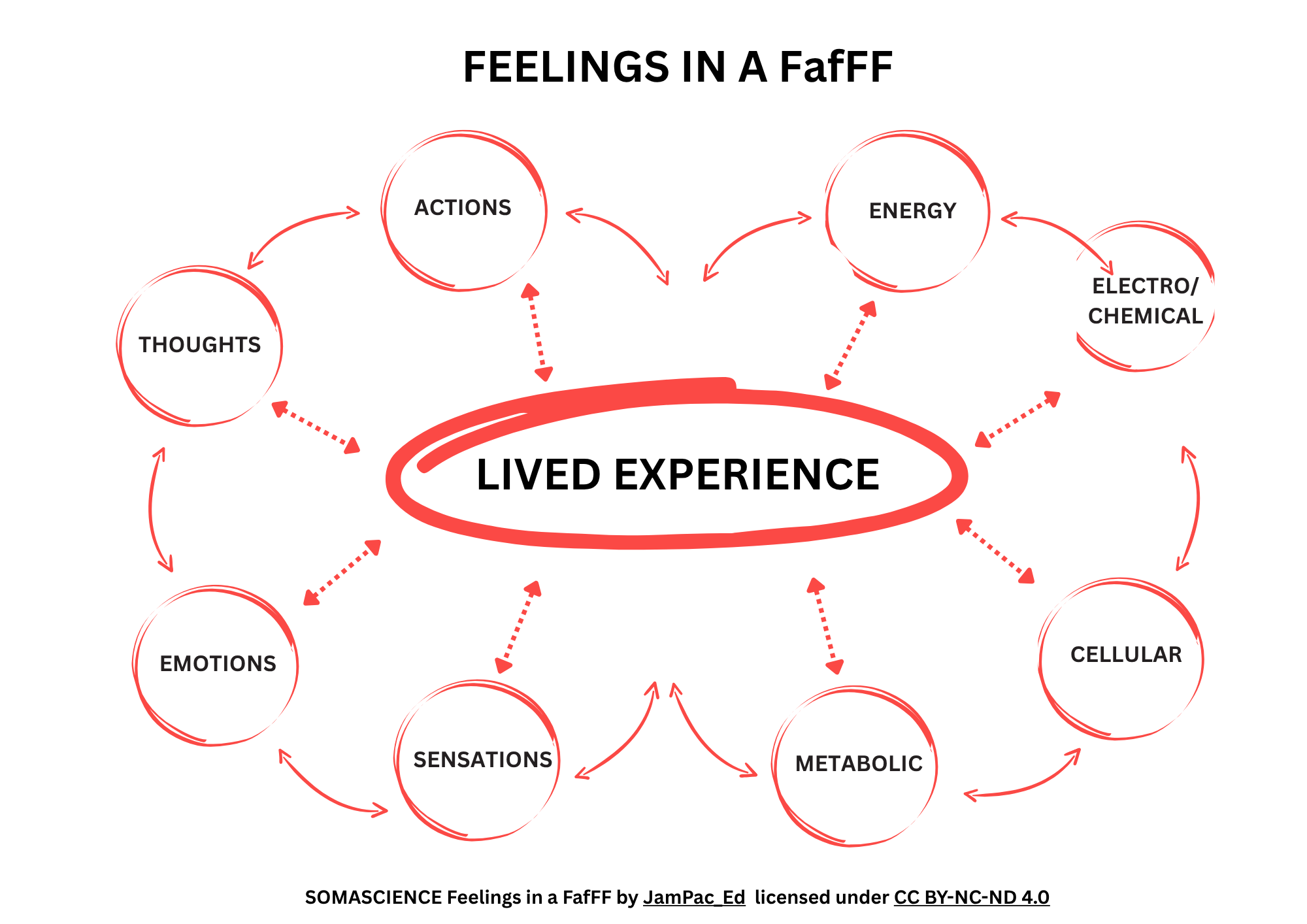
SOMASCIENCE FEELINGS in a FafFF by JamPac-Ed licensed under CC BY-NC-ND 4.0
Ravi is no longer living life LIVE. Their system has reverted to prior protective learning that is limiting their choices in the present. Instead of responding to what they need, they are making a false-safe choice that avoids help and prolongs unnecessary suffering.
While Ravi stays silent, nothing changes — there is no new information for their system to interpret and no relief from the pain. They know their behaviour isn’t making sense, but they don’t yet know what needs to change.
To understand what is happening in the present, we need to look at where the pattern began.
Catching out the FafFF
Let’s ask them about it… “Have you felt this way before Ravi?“
I was about 6 or 7… gosh I haven’t thought about this for ages! It was so awful at the time! I had fallen off my bike and broken my front tooth. My baby sister was sick and my parents were really frustrated that they had to deal with me too. They sent me to the dentist with my old aunt who kept telling me to be quiet and stop making a fuss.
For Ravi at age 6, there wasn’t enough external or internal support available for them to handle the level of discomfort and uncertainty that arose in that lived experience. So they opted for a quick fix protective response: stop sharing your feelings, ‘toughen up’ and do NOT cry!
To avoid feeling that way again their system formed a new somatic communication pattern and their VIP was revised — this is an example of learning contracting into protection. Their behaviour, beliefs and biology rearranged accordingly: discomfort must be endured alone, dentists are unsafe, and to feel safe I need to shut down my FEELINGS.
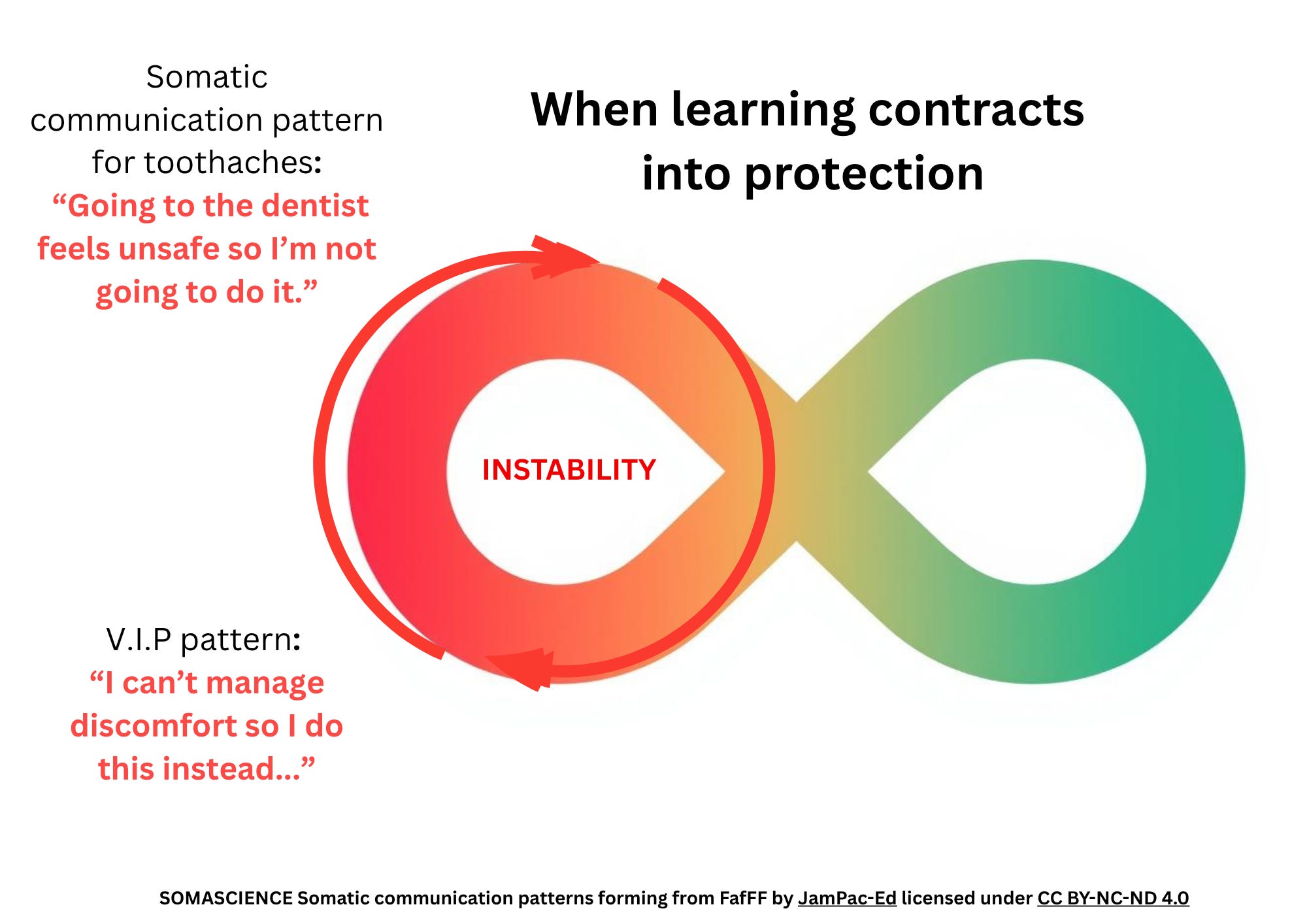
SOMASCIENCE Somatic communication patterns forming from a FafFF by JamPac-Ed licensed under CC BY-NC-ND 4.0
This FafFF became their embodied learning, stored as felt information patterns in their library: when I FEEL that (toothache), I do this to stay safe (avoid my FEELINGS, avoid support, avoid dentists). And 45 years later, Ravi is still using this FafFF to guide their choices.
In this example, the message contained in Ravi’s VIP is: “I can’t handle this discomfort.” By avoiding the help they need, Ravi’s limiting beliefs are driving their behaviour and amplifying inflammation in their biology. This only serves to reinforce the embodied expectation that discomfort cannot be met safely.
So, what’s Ravi going to need to navigate this differently? Let’s help them by introducing some somatic literacy skills…
How embodied safety supports changing a FafFF
Step 1: Ravi notices they are not living life LIVE. They are not taking action that respects their current FEELINGS. They are avoiding facing the discomfort of both the toothache and asking for support.
Step 2: It’s time for Ravi to pause and draw on their understanding of somatic literacy.
Step 3: By orienting to and validating their present FEELINGS, Ravi increases the level of embodied safety in their system so that they can approach this situation differently.
Step 4: Once their system has stabilised, they are ready to be honest with their partner about their reluctance to go to the dentist. Ravi is able to share when they’d felt this way before, and this helps them to identify what the FafFF pattern is and when it formed. They can now see that this old learning is playing out in this current lived experience.
Step 5: Now Ravi gets to choose — repeat the old protective response, or meet the discomfort in a new way.
Instead of withdrawing and disconnecting from his own FEELINGS, Ravi stays feeling connected and open to receiving the support and encouragement his partner offers. They are learning that they can feel scared and sore — AND stay present and make different choices.
As they move through this lived experience with enough external and internal support, their relationship to seeking dental care changes. Ravi is learning that it’s safe to go to the dentist and that they don’t have to suffer in silence alone. Their VIP also upgrades to: “I can handle this discomfort because I can support myself through it”.
By accessing embodied safety while experiencing uncomfortable FEELINGS, a previously contractive pattern is amended. This allows Ravi’s system to expand, learn, and grow — and in this case, reduce unnecessary suffering.
Your turn:
Is a FafFF taking over one of your current lived experiences?
When this happens:
Notice if you are contracting and cutting yourself off from support.
Is this narrowing your choices?
Are you able to source enough embodied safety to navigate the FEELINGS of discomfort differently?
Can you do a ‘Ravi’ and switch back to living life LIVE?
Applied Tip:
By noticing whether a FafFF has been activated, we interrupt old learning that no longer serves us. We get to choose action in the present that better respects our FEELINGS.
This ‘updating in the present’ keeps our library better aligned with who we are now, rather than who we were then. There’s no shame or blame to FafFFs — they are just old patterns of what we learnt to do to feel safe.
Note: some FafFFs get reused so automatically that we lose sense of how the original learning occurred. Go gently as you start to notice when your protective FafFF patterns are active. Reaching out for additional support will help as you increase your internal capacity for supporting yourself through the discomfort.
Support:
Pam can support you to establish a stronger sense of embodied safety, and develop the somatic literacy skills you’ll need to interrupt your FafFFs — so you can start living life LIVE more.
See here for contact details.
Next
This post is one of five in the Conceptual Series. The Applied Blog offers follow up posts for each principle of Somascience.
Here’s Principle #3:

Here’s Principle #1 and it’s Applied Blog:


Here’s Principle #2 and it’s Applied Blog:


Here’s the intro to the Conceptual series:

Meanwhile, use the comments, like, share, restack to share Somascience.