


Note: Somascience is an integrative framework that explores human adaptation and development by examining how we relate to discomfort in lived experience. This Applied Blog supports the application of Somascience in your life. These are posts that align with the Conceptual series - Five Principles of Somascience. For a deeper dive into the philosophical foundation, go here. These posts and the substack The thing is … by JamPac-Ed do not represent medical advice in any way whatsoever [see disclaimer here]. For further support applying or integrating these principles, contact Pam for 1:1 or group Somatic Literacy sessions.

Principle #4 of Somascience states that FafFFs create self-amplifying loops that compromise our lived experience and constrain human potential.
What do we mean by this?
This Applied Blog Post #4 aims to help you understand this mechanism so you can track it in action in your own system.
Let’s unpack it.
How FafFFs operate
Discomfort is an inevitable part of living and an inherent part of learning—we all experience it, and everyone learns to handle different discomforts differently.
Our somatic system has an inbuilt mechanism designed to kick in when there is insufficient internal or external support available to handle discomfort. When it gets too much, the system defaults to a protective response. The aim of these responses is to get rid of the FEELING of discomfort quickly.
A FafFF is the name we’ve given to this “thing we do to try to feel safe” when we feel uncomfortable. The word is an acronym for Fast and familiar Form of Falsesafe.
Here’s a few protective responses you might be familiar with — Fight, appease, fawn, Flight and Freeze. But wait there’s more…
Like…choosing to frame someone else when you’ve made a mistake because taking responsibility felt too hard in that moment. Or…spending endless hours fretting about a difficult work situation instead of supporting yourself through the stress.
We all FafFF—there is no blame or shame in it. JamPac-Ed likes to use “F” words to remind us just how creative our protective responses can become. Do you fret or fixate? Fabricate, fib or fumble? Force, flatten or fester?
FafFFs aren’t signs that something is wrong with us—they’re simply the protective responses our system developed to keep us safe at the time. To read more about FafFFs go here.
The challenge arises when these responses become embedded as learnt somatic communication patterns and are reused automatically — we literally stop living life LIVE. Rather than responding to what’s happening in the present moment, our capacity to adapt, connect and relate becomes increasingly compromised.
Not only that...these quick fix protective responses can become the very thing that makes the situation worse.
How?
By creating self-amplifying loops.
How FafFFs complicate things
FafFF patterns shape our perceptions, choices, relationships and, ultimately, the lives we create.
As we saw with Caitlin and Steve in Principle #4, repeatedly bypassing discomfort through FafFFs creates instability and insecurity loops. Rather than resolving discomfort, our automated protective patterns amplify it.
Although each of us experiences FafFFs differently, the underlying mechanism is universal—and so are the consequences.
Let’s make this relatable...
Meet Marco
Marco has been seeing a psychologist for eight months. He’s gained a lot of awareness about his depression, yet he still regularly becomes overloaded by life. It’s affecting his sleep, his appetite and, by the end of the workday, he’s often crippled by decision fatigue.
Lately, Marco no longer looks forward to new projects. Instead, he feels weighed down by...well, he’s not really sure what. Most days he swings between feeling flat, fretting and fixating. Increasingly, he’s starting to dread work and has been wondering whether anything is ever going to change.
Deep down, he knows he’s been stuck in the same loop for years. He wants to know why and more importantly, how to find a way out.
Seeking answers, Marco begins working with a Somatic Literacy teacher who introduces him to resources that help him understand the different layers of his somatic communication system.
One map in particular makes the loop he is in visible and helps him see why he has felt so unstable, insecure and stuck. For the first time in a long time, he begins to feel hopeful that there might be a way forward.
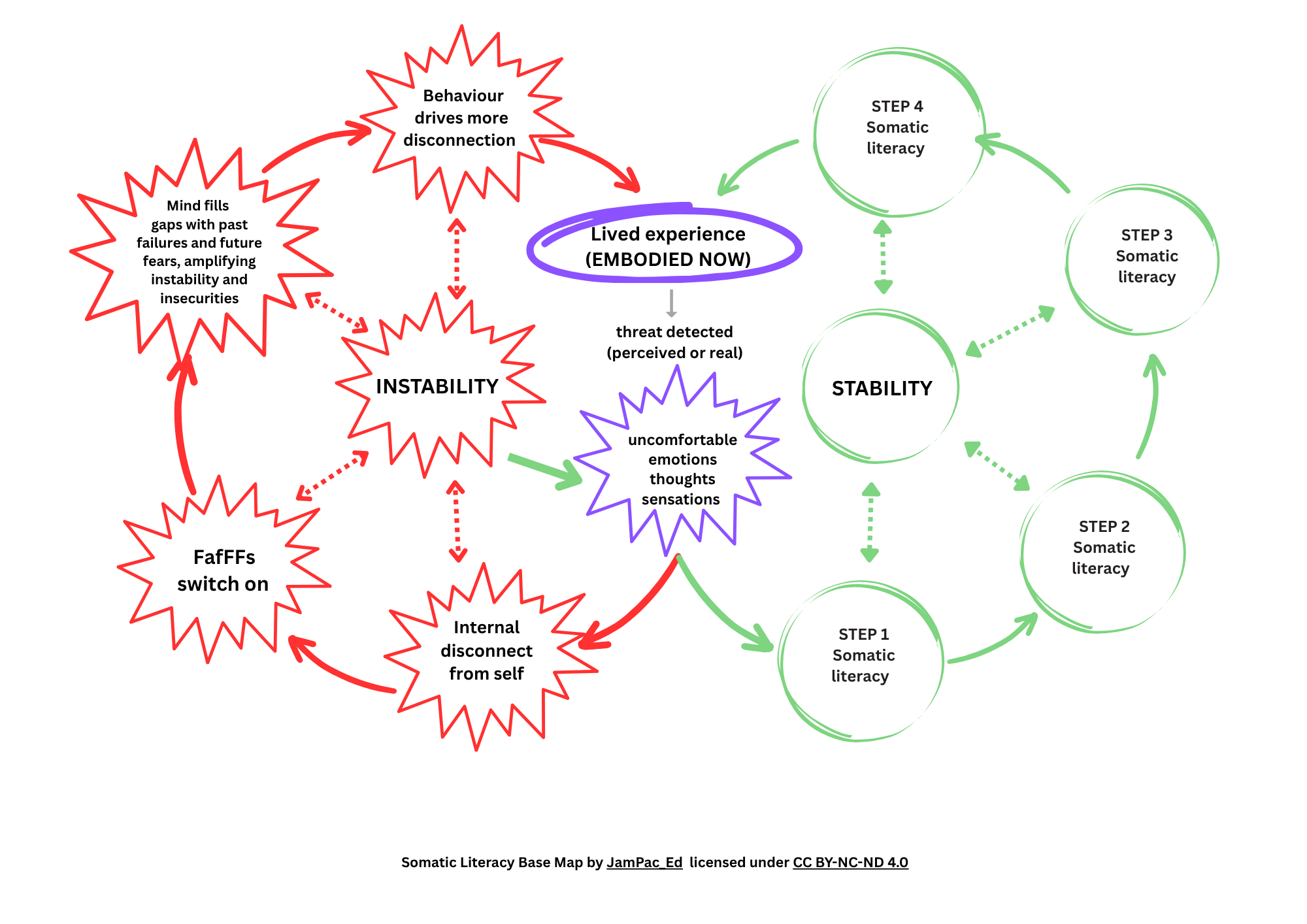
SOMASCIENCE Somatic Literacy Base Map by JamPac-Ed licensed under CC BY-NC-ND 4.0
As Marco relates the red side of the map to his own life, he immediately notices his shoulders tighten and his gut clench as a familiar wave of discomfort floods his system. He acknowledges that life has become taxing — he’s stopped socialising and distracts himself by bingeing on Netflix, while his mind continually fixates on all the things that aren’t going well for him.
Why does an activated FafFF become so overwhelming?
Over time, Marco’s protective responses have become the dominant patterns shaping his experience. His biology, beliefs and behaviour have reorganised around instability. His body has remained on high alert, his mind has been anticipating what could go wrong, and his behaviour has increasingly revolved around avoiding, withdrawing and distracting himself from discomfort.
This has generated additional FEELINGS, layering a growing sense of dread and hopelessness over the original discomfort. Learn more about somaplasticity in Principle #2.
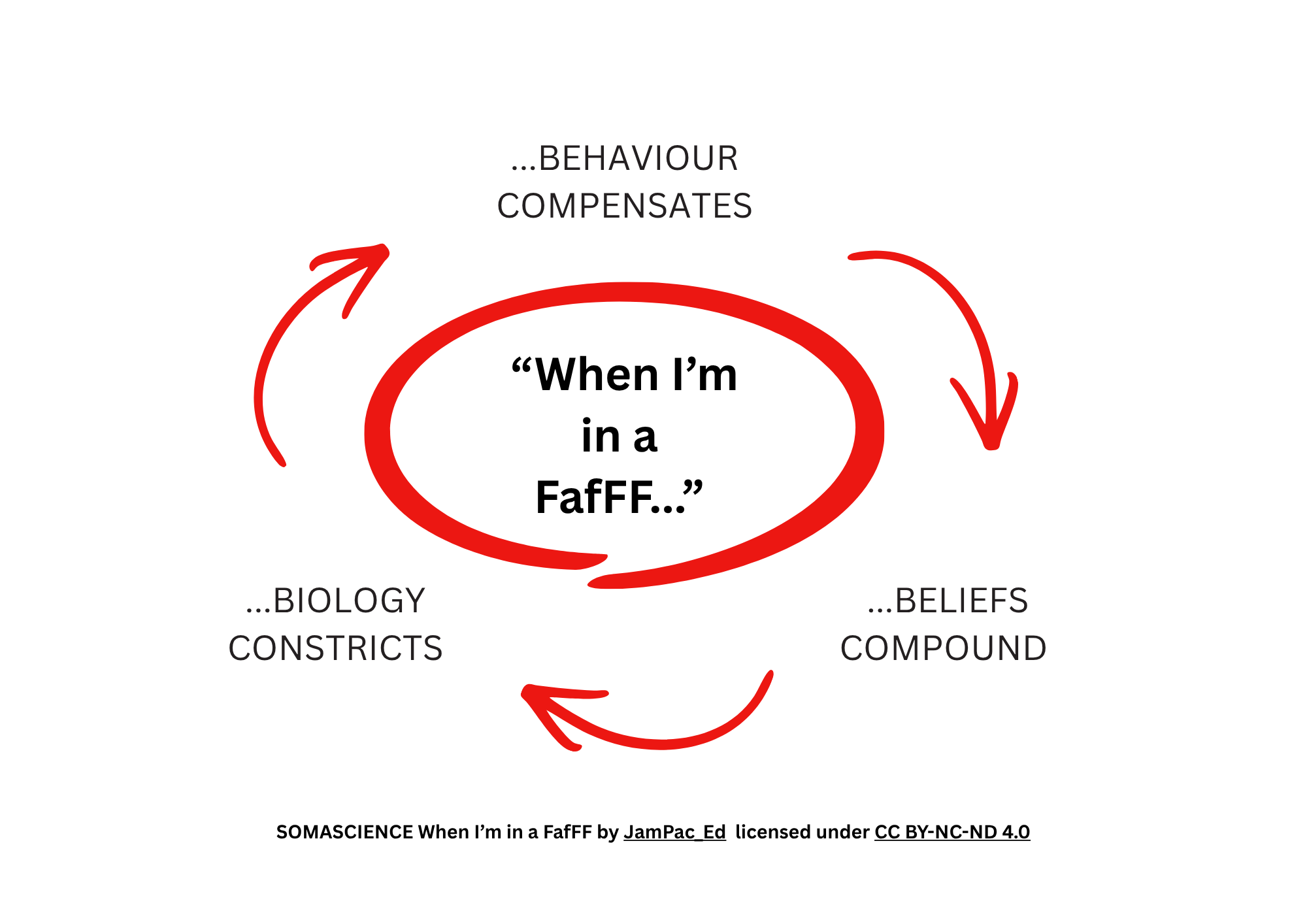
SOMASCIENCE When I’m in a FafFF by JamPac-Ed licensed under CC BY-NC-ND 4.0
Marco can now see that he has become trapped in an instability loop — his destabilized system has been accumulating additional FEELING loads and, unbeknownst to him, his approach to each new lived experience has been adding to the overall level of ongoing instability.
This growing instability is putting pressure on his core motivators—identity, belonging and purpose. His sense of self is being undermined by limiting beliefs that amplify his insecurities:
“I don’t fit in….I’m no good at my job…No-one listens to me…Nothing feels good anymore.”
These insecurities add even more FEELING loads to the system, driving further looping.
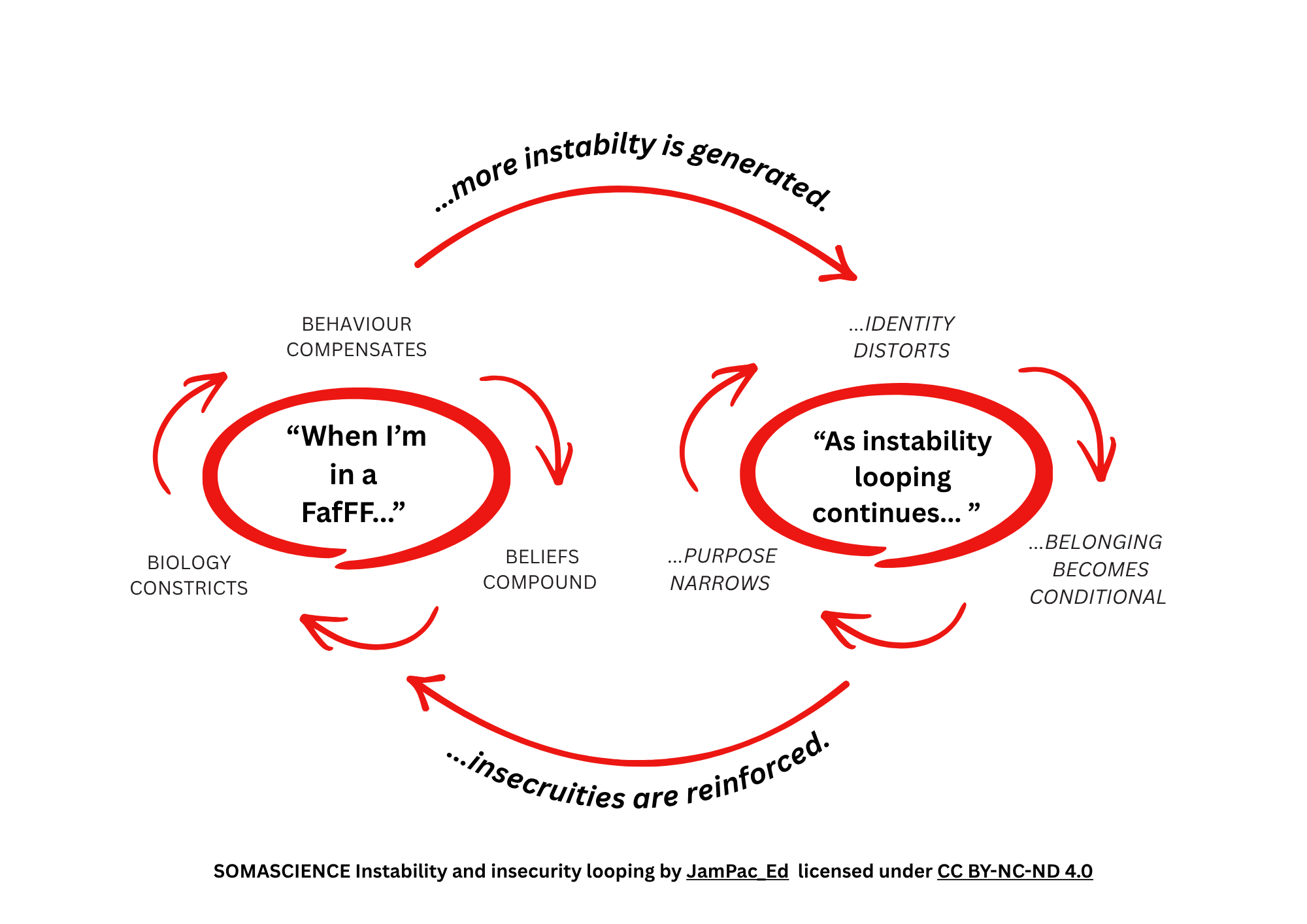
SOMASCIENCE Instability and insecurity looping by JamPac-Ed licensed under CC BY-NC-ND 4.0
The visual brings the pattern into focus. Marco can finally see how his FafFFs (fixating, fretting and going flat) have been perpetuating this cycle.
Viewing his experience through this new lens gives him a completely different perspective. The quick fix solution has become the problem — as the more he tried to escape discomfort using old patterns, the more instability and insecurity looping was generated.
As Marco begins making sense of this experience, what once felt confusing sparks a genuine curiosity to learn more and find a way out of the stuckness.
The full impact of FafFFs
Marco is beginning to appreciate the full impact of what has been happening inside him. What he previously experienced as overload, tiredness, confusion, decision fatigue, headaches and loss of appetite, he now recognises as the consequences of persistent somatic inflammation.
Using the Somascience framework, Marco can, for the first time, distinguish between the different FEELING loads within his system and understand how they interact to create self-amplifying loops.
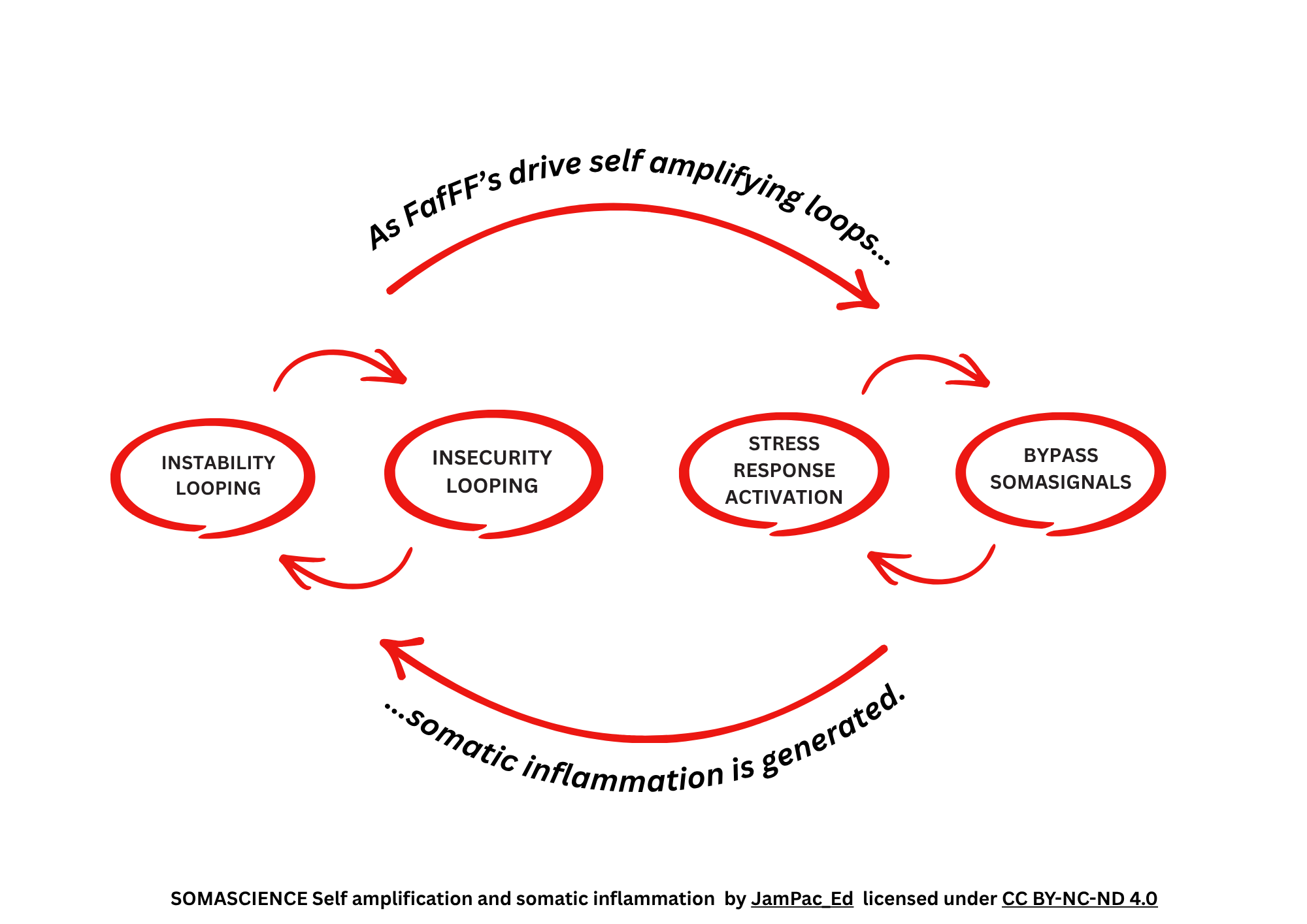
SOMASCIENCE Self amplification and somatic inflammation by JamPac-Ed licensed under CC BY-NC-ND 4.0
Rather than recognising and responding to his somasignals, Marco has been automatically bypassing them by FafFFing. Each time he does, his stress response remains activated, somatic inflammation accumulates, and the loops reinforce one another.
Can you see how Marco’s FafFFs have kept his whole system in a protective, destabilised state?
Protectiveness has become his system’s default operating mode. Being stuck in this state is like wearing red glasses—a protective lens that has gradually coloured how he experiences himself, other people and the world around him.
This is what we mean when we say that Principle #4 of Somascience states:
FafFFs create self-amplifying loops that compromise our lived experience and constrain human potential — compounding suffering and limiting our capacity to communicate, collaborate and adapt.
The way out of self-amplifying loops
Marco realises that, with curiosity, understanding and sufficient support, it is possible to take off the red lens and find a way out of the stuckness.
How?
It begins by recognising the mechanism.
Now that Marco can see what’s happening, his protective response and patterns make sense. At some point in his life, when he wasn’t sufficiently supported to work through a FEELING of discomfort, his system did exactly what it was designed to do—it protected him.
When discomfort arose, Marco’s system discovered that withdrawing, fixating, fretting and going flat helped him feel safe. Over time, repeatedly responding this way turned those protective responses into an automatic somatic communication pattern.
Essentially, he became what he learnt to do to feel safe.
He didn’t just withdraw—he became withdrawn. He didn’t just fixate—he became fixated. He didn’t just fret—he became fretful. He didn’t just go flat—he became flat.
Marco is struck by the significance of these realisations. His FafFFs have made life so much harder and he’s never learnt how to actually handle discomfort.
If you’ve recognised parts of yourself in Marco’s story, perhaps you’re beginning to see your own self-amplifying loops more clearly. For Marco, this new understanding creates the possibility of choice. And with choice comes the opportunity to participate in new learning about his somatic communication system that supports greater stability, connection and adaptability.
Applied Tip:
Think of a challenging situation in your life, and use the map to identify where your protective patterns may be creating instability or insecurity loops.
Can you relate to the self-amplifying nature of these mechanisms?
Are the things you are doing to feel safe and loved actually increasing somatic inflammation in your system?
Curious to learn more?
Support
Pam offers a range of Somatic Literacy resources through Feeling Connected to help you bridge the gap between understanding the Somascience Principles and living them. Learn to recognise your protective patterns, understand how self-amplifying loops shape your lived experience, and develop practical skills that support greater stability, connection and wellbeing.
Next
Head to the Conceptual Series and the Applied Blog to apply Somascience principles to your life:
Go here to see the Principles
Go here to see the corresponding Applied Blog posts
Meanwhile, use the comments, like, share, restack to share Somascience.