


What is a somatic communication system?
We are body-based beings — living, breathing organisms best understood from the body up. The Greek word soma means “the body in its wholeness.” Simply put, being alive is a whole-body event — a somatic felt experience.
Our being, aka our soma, is a complex decentralized set of interconnected hubs and subsystems which operate as a whole. We are thus better described as a system.
The parts of our somatic system communicate with each other via the language of FEELINGS, a complex and constant conversation of somasignals which includes everything from chemical signalling and sensations right through to the thoughts that motivate our actions.
Understanding these somasignals is the first step towards cultivating somatic literacy — learning how to orient towards, validate, understand and respond to our somaintelligence.
The communication of the system is highly sophisticated — it is our somaintelligence. Omnipresent, ubiquitous and visceral – it’s somatic. We are born with this somawisdom and it’s our primary source of information for living. Therefore understanding how it works and how to use it is important.
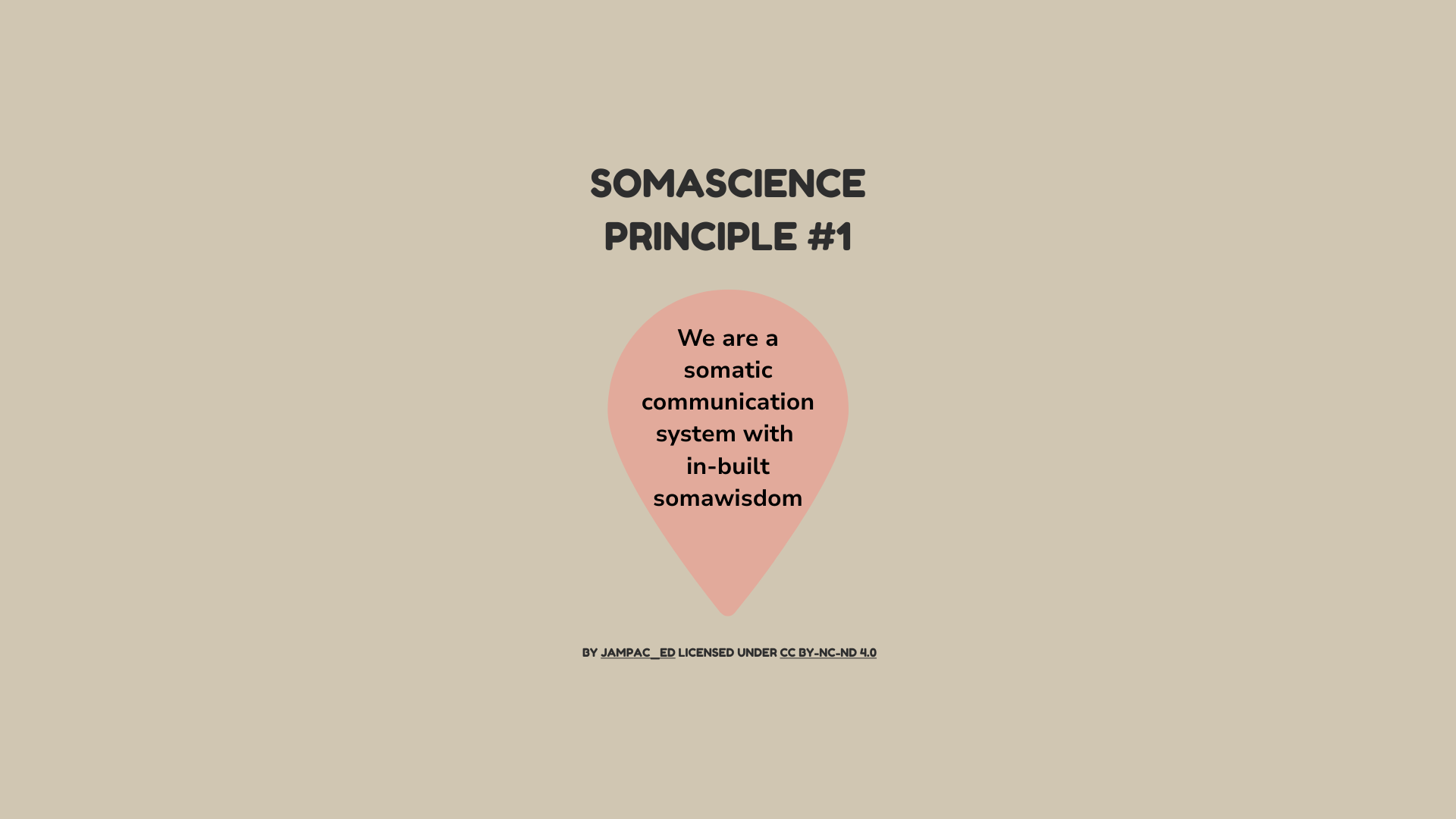
When we see ourselves in this way we shift the conversation about the human experience to: we are a somatic communication system with built in somawisdom, and somatic literacy is an essential tool for navigating life.
What are soma signals?
Somasignals are FEELINGS — the language of our somatic communication system. They are messages transmitted through a complex and integrated network of receptors and transmitters that synthesise information at every layer of our being.
These signals are both visible and invisible to the human eye, audible and inaudible to our ears. They include our actions, thoughts, emotions, sensations, metabolic happenings, cellular activity, electrical impulses, and chemical signalling. At their most essential level, they are embodied energy in motion. All of these signals together are what JamPac-Ed defines as FEELINGS.
This broader definition of the word ‘feelings’ (written in capitals) encapsulates the interconnected complexity of the system. These communications are like lights on an internal dashboard, a constant signalling by the soma about the status of our being.
From the genetic code that drives cellular activity, to neural signals firing across synapses; from the immune system activating in the gut, to chemical sensitivities in the skin; from a new thought popping up, or a strong emotion arising; to a new sensation in the right shoulder, or even a conscious impulse to take action — communication in our system is constant, dynamic, and happening in every now moment. It is our somaintelligence.
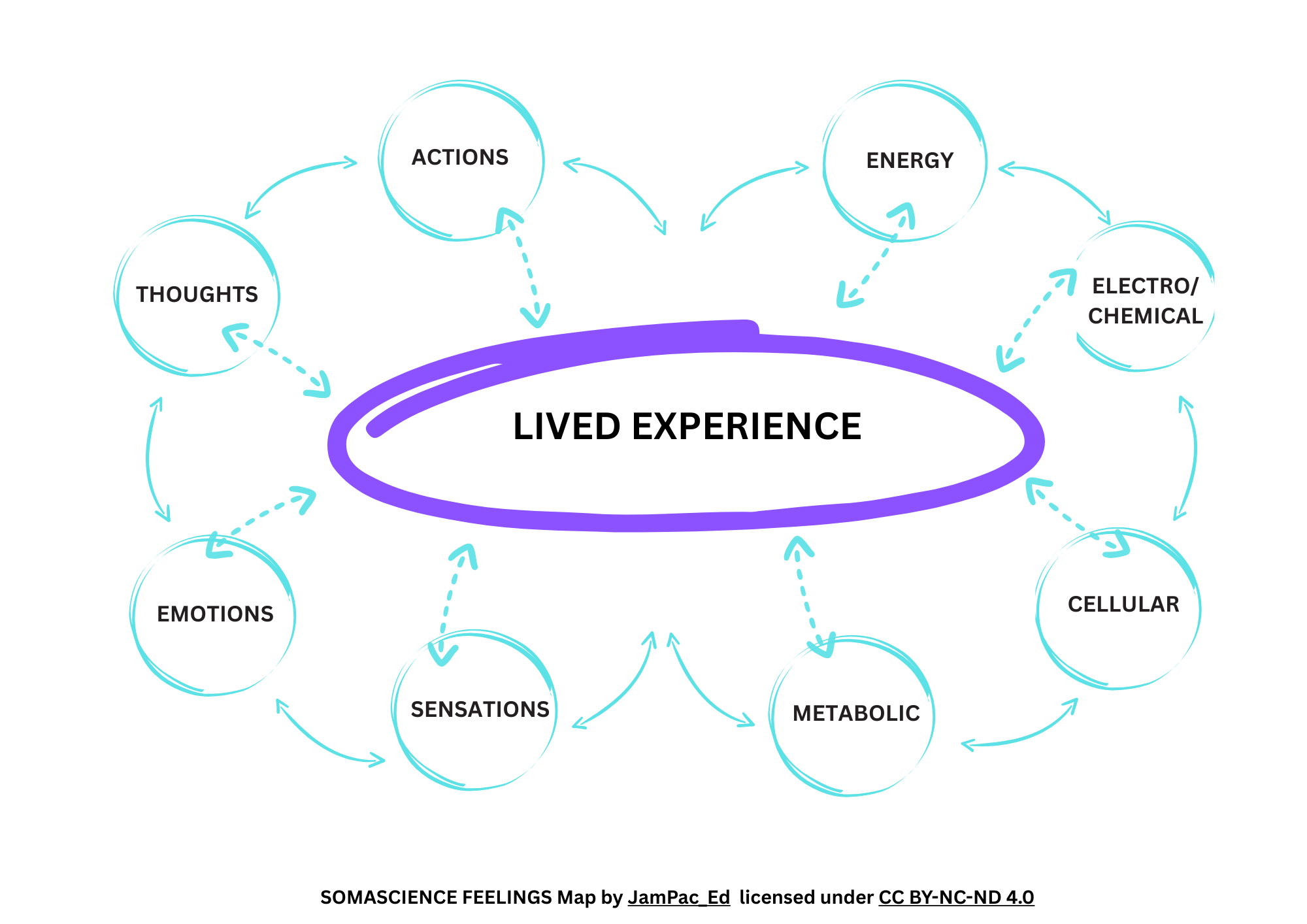
SOMASCIENCE FEELINGS Map by JamPac-Ed licensed under CC BY-NC-ND 4.0
This somaintelligence is innate to our system. It’s what a baby uses when it cries in response to hunger or a wet nappy. It’s the system’s way of detecting change (internal and external) and responding to the discomfort of the FEELING.
Our connection with this information is vital - it’s what guides how we navigate our experience of life.
Here’s how this looks in a real life situation
Rosa is listening to a Zoom workshop when she notices a couple of internal messages — a tightening in her left shoulder, and an urge to yawn. More lights are flashing on her internal switchboard. There are underlying metabolic, and chemical shifts occurring throughout her soma.
Because she’s attuned to her soma signals, she stands, rolls her shoulders, stretches, drinks some water, and takes a few deep breaths. She’s checked in with her FEELINGS, and chosen actions that respect and support her system.
As Rosa’s example illustrates, how we respond to our somasignals is the lifeline to our wellbeing.
Without somatic literacy she might have ignored the signals and pushed through. This choice would have had a knock on effect on the quality of her learning and the level of discomfort in her body.
Our relationship to our FEELINGS matters
Let’s look at this more closely. When we acknowledge our FEELINGS, we are literally saying, “Yes, thank you — I hear you, my somaintelligence, and I will respond to your message.”
This is the first step in somatic literacy — connecting to our system’s soma signals. By attuning to these messages we are validating the significance of this information and how it is being shared across the entire system. Having ‘heard’ the message, we can then ‘heed’ it by taking action that respects our FEELINGS and supports our overall wellbeing.
By orienting ourselves to our FEELINGS, we’re not only ensuring our changing needs are met - we’re also strengthening our relationship with the system itself.
Reinforcing the pathways of our somaintelligence reminds us that we are somatic based beings — capable of orienting towards and trusting our own system for guidance in navigating our lives.
However, when we, or others, do not respond to or don’t respect our FEELINGS, it invalidates them. Our relationship with our somaintelligence becomes fractured. As a result, the communication pathways can reroute, derail, subvert, or destabilize our human experience.
This discordance can create patterns that, over time, can be very damaging to our system. It can even affect the communications themselves - amplifying or muting the signals.
Disconnection from our soma signals doesn’t just erode internal trust, it triggers stress responses and inflammation. Left unchecked, this has biological and behavioural consequences and implications for our beliefs, sense of belonging and self identity.
Why this is important
This is key to Somascience Principle #1: Validating the communications of the system stabilizes it.
Each time we choose to reorient ourselves toward our somasignals, we take responsibility for our relationship with our own FEELINGS. This validation brings stability and embodied safety to the system.
The nature of our relationship with our somasignals has a direct influence on our biology, behaviour, beliefs —- as we will see in Principle #2.
How we relate to FEELINGS of discomfort, uncertainty and instability especially shapes our sense of identity — as we will see in Principle #4.
Applied tip:
When you notice a shift in your thoughts, emotions, sensations or metabolic happenings, pay attention and orient towards them rather than turn away. If this feels too uncomfortable, there are tools you can learn to use that make this easier.
This act of orienting towards your FEELINGS validates the messages, respects the system, and brings stability.
Next?
Read the Applied Blog posts that link to Principle #1:

This post is one of five in the Conceptual Series — the Five Principles of Somascience. Here’s the link to the Introduction to the series:

Use the navigation bar on the home page to find the other posts in the Conceptual series and Applied blogs.
Meanwhile, use the like, comment, share or restack to engage.
Love that, and as a late diagnosed autistic who was highly masked, it explains perfectly the disconnection with my FEELINGS. Thank you ❤️
yeah! you're speakin' my language :)