


We are designed to handle uncertainty and change. As a somatic, experiential and pattern-based learning system, we have an inbuilt mechanism for registering when we have been destabilised. It’s called discomfort, and it’s an inherent part of life.
As we saw in Principle 3, pattern based learning shapes our system. While protective FafFF responses may provide temporary relief, relying on these learned patterns as our primary way of managing discomfort ultimately leaves the system more destabilised.
Principle #4 reveals the significant consequences of these falsesafe quick fixes and how they compromise our human experience.
As behaviour, beliefs and biology reorganise around protection, we lose connection to our internal navigation system. This instability looping interrupts the system’s ability to develop embodied safety as a source of internal stability.
As instability increases, our core motivators shift — identity distorts, belonging becomes conditional, and purpose narrows. This is insecurity looping — where our sense of worth becomes increasingly externally referenced, while our experience of intrinsic worth diminishes.
Instability and insecurity looping create a powerful paradox. As attention and energy are redirected towards securing safety and worth externally, unmet discomfort and further FEELING loads accumulate internally. The very attempt to bypass discomfort becomes the mechanism that drives somatic inflammation and limits our capacity to cultivate our own intrinsic worth.
Understanding the hidden costs of FafFFs creates an opportunity to reclaim our capacity to respond to discomfort differently. In doing so, we can interrupt the self-amplifying dynamics that constrain and compromise our human experience.
FafFFs reorganize the system around instability
As humans have evolved, our somatic communication systems have developed increasingly ‘creative’ ways of (mis)managing discomfort. These protective responses activate when insufficient internal or external resources are available to support discomfort as it arises.
These FafFFs are not failures — they are the system’s resourceful attempts to handle discomfort in the moment. Primitive protective responses such as fight, flight or freeze have evolved into more sophisticated behavioural patterns such as fret, fixate, flex, fix, fuss, fib or fade, to name a few.
While they provide temporary relief, they neither acknowledge nor address the initial FEELING of discomfort that triggered the response. Instead, these fast and familiar forms of falsesafe disconnect us from what is true for us in the moment.
When a FafFF is followed up with internal and/or external support, the system can return to living life LIVE . However, when the discomfort driving the FafFF remains unsupported, the system stays destabilized and on alert.
Somaplasticity is the process through which the system then reorganises around this instability. Behaviour compensates to avoid further discomfort, beliefs compound around past failures and future fears, and biologically, the stress response constricts communication within and between the body’s hubs and subsystems
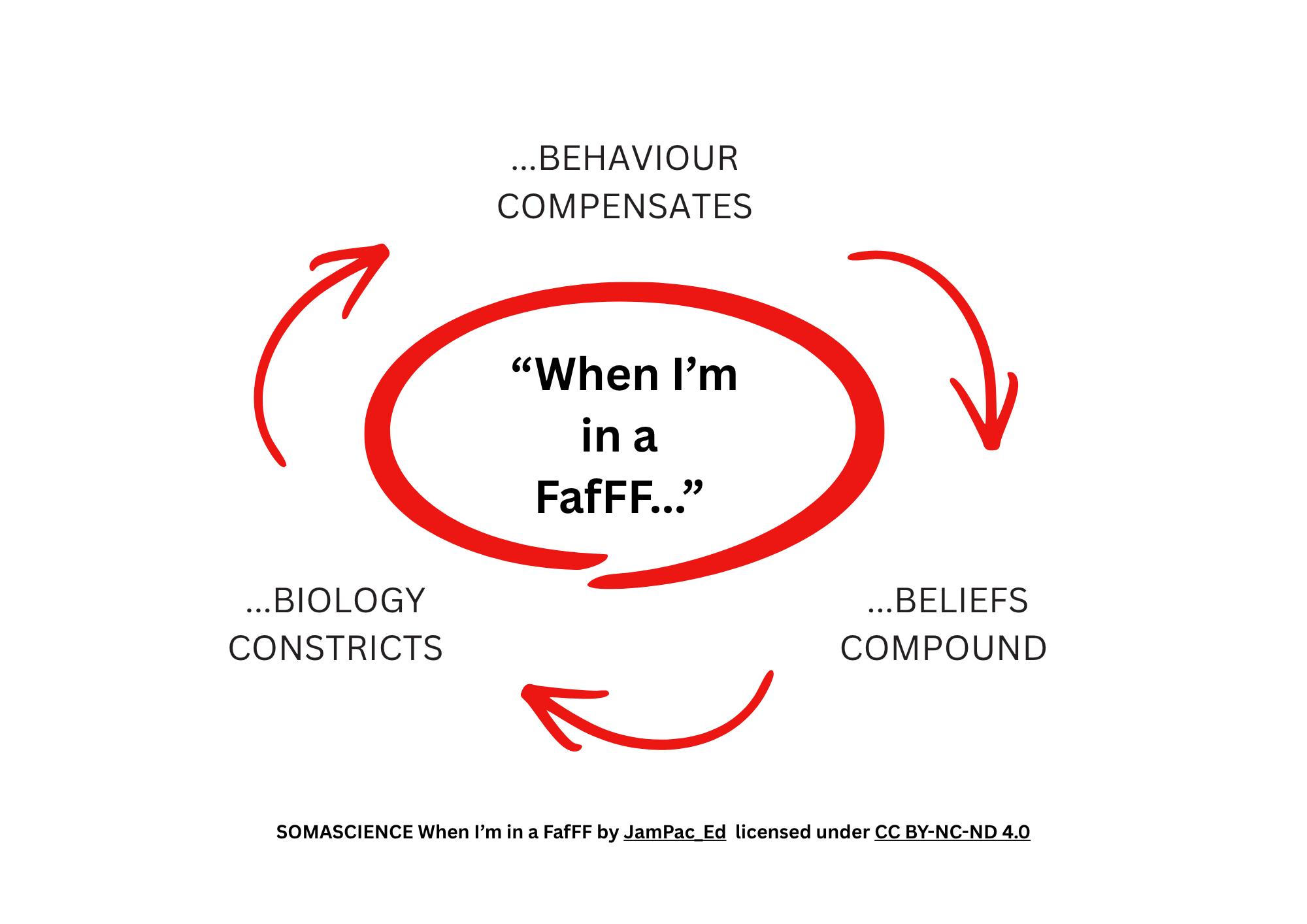
SOMASCIENCE When I’m in a FafFF by JamPac-Ed licensed under CC BY-NC-ND 4.0
Repeated use of a FafFF creates a somatic communication pattern that becomes the system’s automatic response to that particular discomfort. This generates instability looping - narrowing context and reducing the choices we feel able to make in everyday life.
In this state, the important developmental process of attuning to our own FEELINGS and establishing embodied safety through internal and external support is interrupted.
From instability to insecurity
Without an internally anchored source of stability, uncertainty and overwhelm increase, causing our core motivators to fluctuate and insecurities to emerge. As a result, the search for safety alters our perception of ourselves, others and the world around us.
Our identity collapses, warps, or inflates in response to external feedback. Belonging becomes conditional or performance based, while purpose narrows around seeking external validation of our worth.
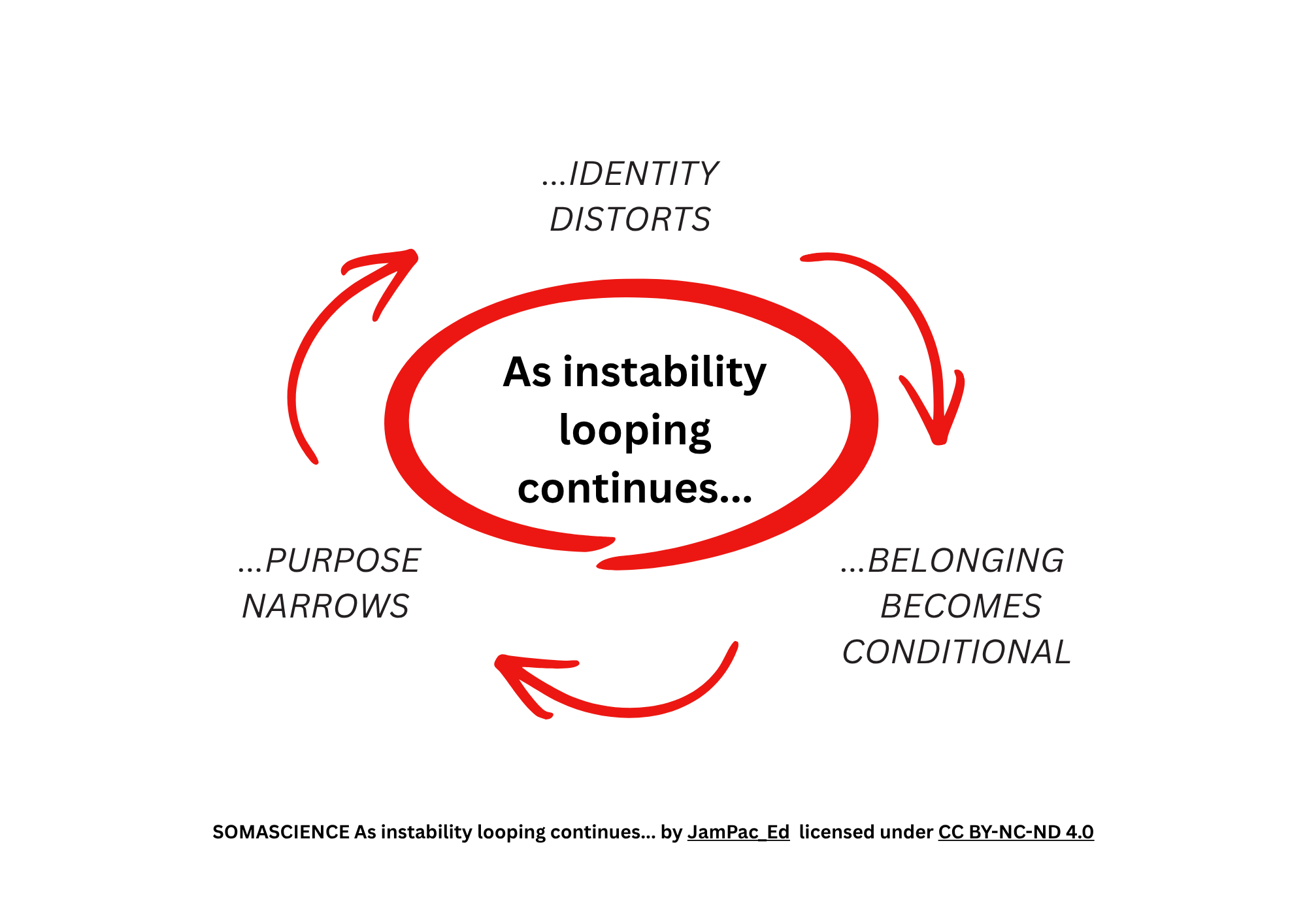
SOMASCIENCE As instability looping continues… by JamPac-Ed licensed under CC BY-NC-ND 4.0
The impact of insecurity looping is felt both internally and externally. Embedded limiting beliefs undermine our sense of self internally, while we increasingly seek worth externally through our actions, possessions, achievements and relationships.
In this state, the important developmental process of exploring our own identity and sustaining our own intrinsic worth is inhibited.
What does this all look like in real life?
Steve and Caitlin work for a large IT company and are attending a team building workshop.
Steve is new to the company. To avoid the discomfort of not knowing anybody, he ‘big notes’ himself. In the breakout group, he raves about his old job, suggests grandiose ideas and insists he’s right. When the others don’t respond positively, he baulks — throws back his chair and storms off, leaving the group confused and frustrated.
Notice Steve’s FafFF protective response is to flex. The more Steve projects overconfidence, the more unsettled he becomes. This is instability looping: his body tenses and his thoughts become preoccupied with proving himself right, while the discomfort of his nervousness remains unmet.
As instability increases, insecurity looping takes hold. Steve references past achievements to seek validation and belonging. His outburst is a final attempt to be seen and acknowledged. When this fails, he disconnects completely — convincing himself he doesn’t need anyone and can do better alone. Ironically, the very strategies that Steve uses to try to feel included are reinforcing his insecurities, pushing him even further on the outer.
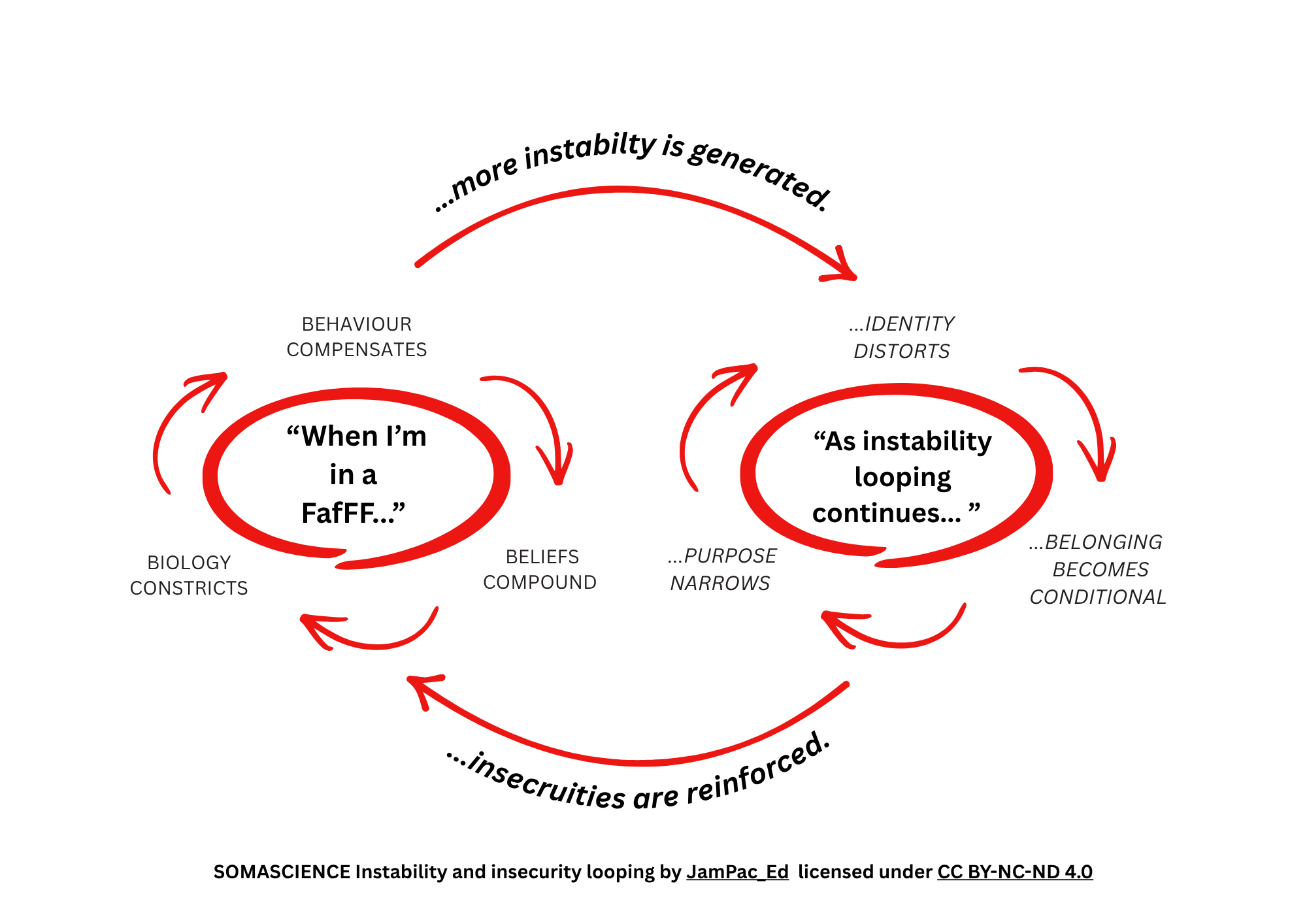
SOMASCIENCE Instability and insecurity looping by JamPac-Ed licensed under CC BY-NC-ND 4.0
For Steve, instability and insecurity looping are taking away his freedom to be himself. He has become so focused on securing safety and proving his worth externally that others never get the opportunity to know him beyond the protective persona he presents.
Self-amplifying loops and somatic inflammation
When FafFF responses become the primary strategy for managing discomfort, instability and insecurity loops become self-amplifying. This leads to somatic inflammation — complicating and compromising communication across the whole system.
Back to the story example…
Caitlin has been with the company a long time and is keen for a promotion. She starts the session by making sure everyone else is comfortable, while internally she is preoccupied with how she is being perceived. Outwardly she appears confident and capable, but internally a migraine is looming and she’s having trouble concentrating.
Caitlin is attempting to bypass the discomfort and uncertainty about her promotion by fretting — this is her FafFF pattern. But her instability and insecurity loops are self-amplifying and she is unaware that the heightened activation of the stress response is generating somatic inflammation.
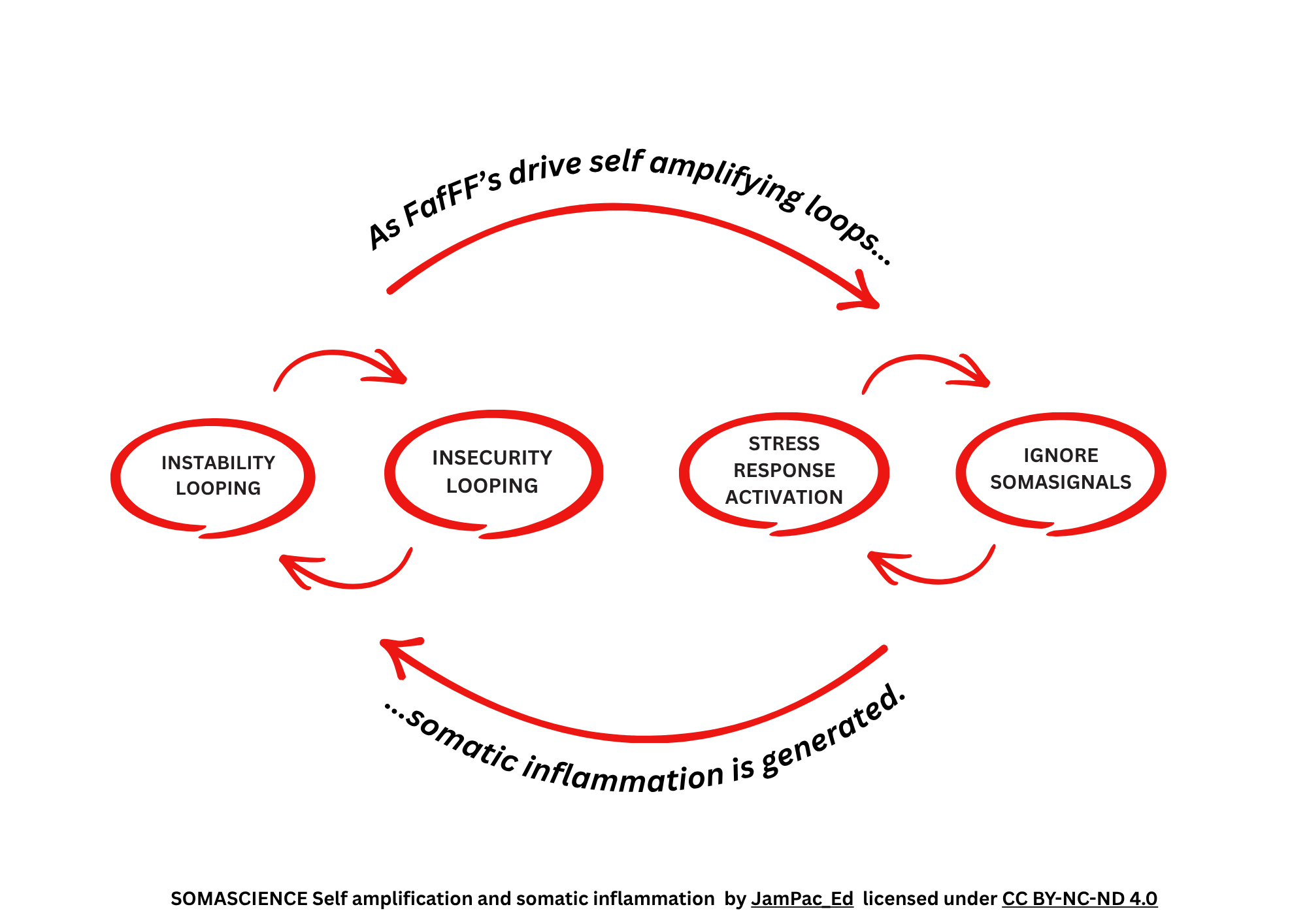
SOMASCIENCE Self amplification and somatic inflammation by JamPac-Ed licensed under CC BY-NC-ND 4.0
Caitlin becomes so fixated on contributing in ways that attract positive feedback that she invalidates her soma signals and neglects her own physical needs. And the harder she works to prove her worth, the more inflamed her system becomes and the less access she has to her natural abilities and capacity for leadership.
Herein lies the core paradox of Caitlin’s lived experience. Her repeated attempts to avoid discomfort and secure safety are generating chronic somatic inflammation and further diminishing her self worth.
While Caitlin’s and Steve’s stories are unique, the patterns driving them are not. These are the dynamics that underpin many of the struggles we all face.
What begins as an attempt to secure safety externally, actually narrows our experience of life, constraining the very capacities needed to manage uncertainty, learn and grow.
The deeper hidden costs of FafFFing
When FafFF protective responses become the system’s default mode of operation, the human capacity for communication, collaboration and adaptation is compromised.
This is not just happening within individual systems — the effect is cumulative across generations.
Communication is distorted - The system becomes hyper- or hypo-responsive to FEELINGS, making them overwhelming or inaccessible. Unreliable signalling between the body’s hubs and subsystems makes information harder to accurately interpret and respond to. This compromises our health and creates more confusion and uncertainty.
Collaboration is conditional - As purpose narrows around controlling external outcomes, relationships become more transactional and less collaborative. The tension between being ourselves and maintaining belonging often leads to unhealthy compromise, eroding trust in ourselves and diminishing the quality of our relationships with others.
Adaption is constrained - Persistent self-amplifying looping sensitises the system to uncertainty, so change itself becomes a threat. The system’s window of tolerance narrows until somatic inflammation becomes its baseline state. Over time, we no longer simply register discomfort — we begin to anticipate unsafety.
Why this matters:
While more energy is spent bypassing discomfort, protecting worth and controlling outcomes, FEELING loads continue to accumulate. The individual and collective cost to humanity is immense: an accumulation of unnecessary suffering and a loss of human potential.
Understanding the mechanisms driving instability and insecurity looping reveals a pathway out and unlocks new possibilities. Learning to navigate discomfort differently reconnects us to our internal navigation system — our somaintelligence — creating the conditions through which embodied safety and intrinsic worth can be nurtured.
As we return to living life LIVE, we reclaim our capacity to value ourselves and what matters to us in the present moment. In doing so, we create the conditions in which life feels safer and we are freer to be ourselves. This restores our ability to communicate and relate in creative and collaborative ways, supporting human potential to flourish.
Applied Tip:
Next time you’re in a FafFF, notice what your thoughts are focused on and what sensations are moving through your body.
How are these FEELINGS influencing your behaviour?
What feels uncertain, overwhelming or unstable right now? Where are you orienting for safety, belonging and validation?
Most importantly, what discomfort are you using the FafFF to avoid?
Understanding this creates an opportunity to respond differently and return to living life LIVE.
Next
This post is one of five in the Conceptual Series. The Applied Blog offers follow up posts for each principle of Somascience.
Here’s the first 3 Principles and intro to the series:


Meanwhile, use the like, comment, share or restack to engage.